For most of construction's history, HR and safety lived in different worlds. HR handled hiring, payroll, benefits, and the paperwork that comes with employing people. Safety handled orientations, inspections, and incidents out in the field. The two functions reported up different chains, ran on different software, and often only spoke to each other when something went wrong.
That separation is ending, and HR and safety are becoming closer than ever. The HR professional in construction is taking on a wider role, one that reaches past the office and onto the jobsite. Work that HR and safety once handled separately now moves across a shared foundation, because the same workforce sits at the center of both jobs. When the person who onboards a worker can also see whether that worker finished their site orientation, holds the right certifications, and is showing up where they are supposed to be, HR and safety stop working in isolation and start reinforcing each other.
This article looks at how roles are changing, why it is happening now, and what HR and safety professionals gain when onboarding, culture, certifications, time, and compliance all run from one connected view of the worker.
The old divide
Most construction companies still run HR and safety on separate systems, and the two rarely talk. Hiring, payroll, benefits, and certifications sit in one place. Orientations, pre-task plans, observations, and incidents sit in another. That works until an OSHA audit, an EMR review, or a certified payroll request lands, and the office spends days reconciling the same workers across both systems.
The cost of that divide is not just wasted time. It is risk. When the office record and the field record disagree about who is qualified, who was trained, or who was even on site, the company cannot prove its own compliance. The HR professional ends up answering safety questions they have no visibility into, using data they do not control.
Why the role is changing now
Several forces are drawing HR and safety into closer partnership at the same time:
- OSHA enforcement on multi-employer worksites is tightening. General contractors are increasingly accountable for workers of their subcontractors, which makes workforce data a compliance asset rather than a back-office formality.
- Insurance carriers are scrutinizing EMR harder and tying loss control directly to coverage. The documentation that proves good safety practice now lives partly in HR records.
- Owners want real-time visibility into safety and compliance, not quarterly PDFs assembled after the fact.
- The workforce itself has changed. Crews are more multilingual, turnover is higher, and more of the labor on any given project belongs to subcontractors. Onboarding has to do more, faster, in more languages, and it has to stick.
Put together, these forces make the worker record the most important thing the company owns. And the person who owns that record is HR.
The expanding HR and safety opportunity
The modern HR professional in construction is responsible for far more than hiring and payroll—and increasingly works hand in hand with safety. Together, the two functions now reach into territory that used to be handled separately, or not at all:
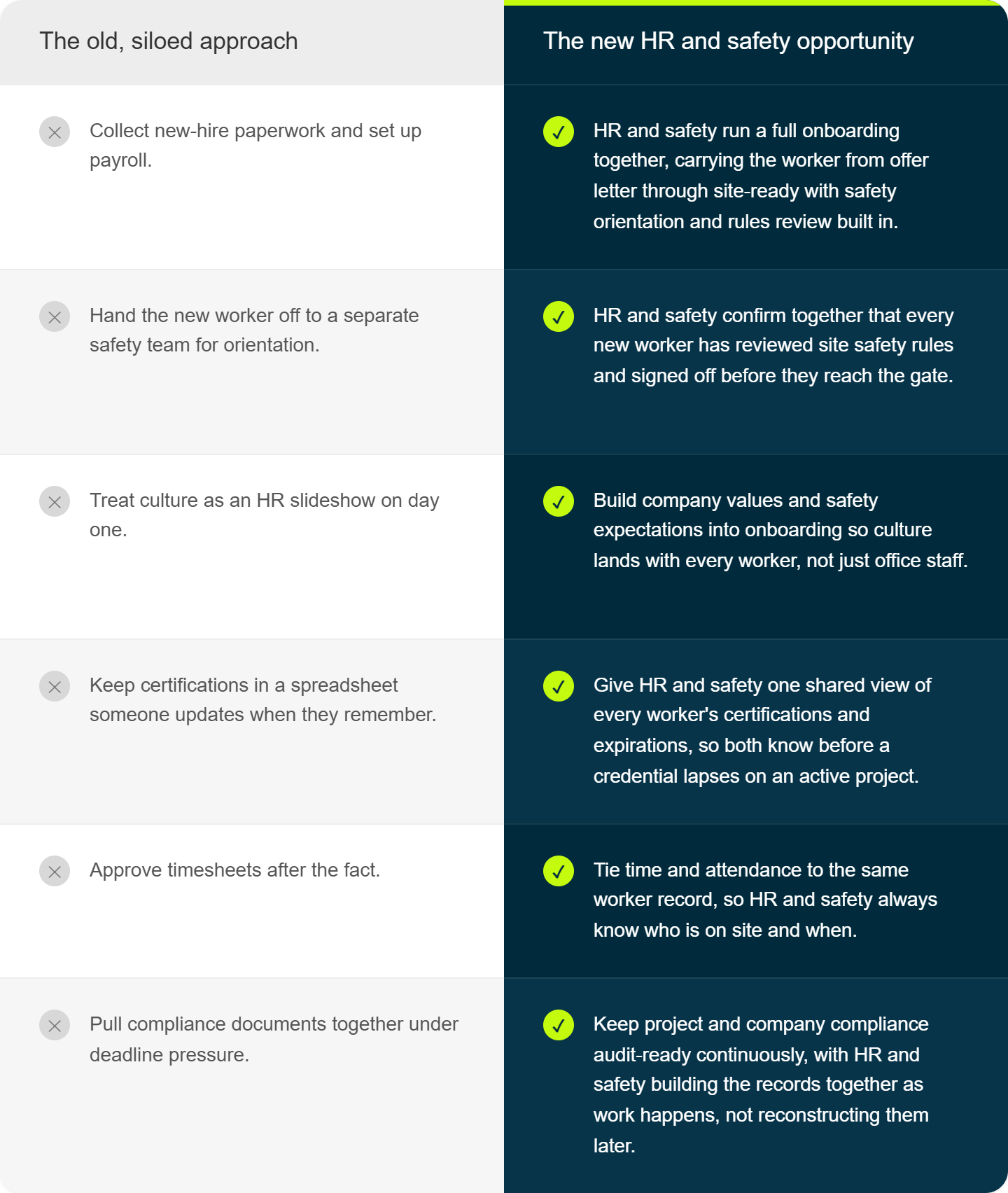
None of this means HR has absorbed the safety department—and it should not. It means the two now share a foundation and depend on each other to succeed. The HR professional owns the worker record, and safety happens on that same record, so the back office and the field finally work from the same set of facts about the same people.
One connected view of the worker
This shift only works when the technology underneath it does. If HR onboards a worker in one system and the field re-enters that worker in another, the divide is still there, just hidden. The point of the new HR and safety partnership is a single, source of truth for each worker.
This is the idea behind the partnership between Arcoro and SkillSignal. Arcoro handles the office side, with applicant tracking, onboarding, HRIS, payroll, benefits, time and attendance through Arcoro Time (formerly ExakTime), and learning management, all built for construction rather than adapted from generic HR software. More than 7,000 construction companies run on it, and it keeps them current on I-9 verification, ACA reporting, multi-state labor rules, and certified payroll.
SkillSignal handles the field side, with project-specific mobile orientations in 14 languages, AI-assisted pre-task plans and job hazard analyses trained on OSHA 29 CFR 1926, site access verification at the gate, daily observations and inspections logged in the field, and incident reporting aligned with OSHA 1904. SkillSignal runs across more than 6,000 US projects with over 135,000 workers and 150-plus general contractors.
Employees set up in Arcoro flow into SkillSignal, so both sides run off the same workforce data instead of entering it twice. More than fifty construction companies already run both. For the HR professional, that means onboarding status, safety orientation completion, certifications, time, and compliance all trace back to one record they actually control.
What this means for HR and Safety
The HR and safety roles in construction are becoming bigger and more strategic—and more effective when they work together. It is now a compliance and risk-protection function as much as a people function. The HR professional who can show, on demand, that every worker on every project was hired correctly, oriented to the site, trained in the rules, currently certified, accounted for, and documented is no longer doing back-office administration. They are protecting the company's ability to win work, hold its coverage, and pass an audit without scrambling.
Getting there does not require building a bigger department. It requires connecting the systems that already hold the workforce, so the office and the field finally agree on who the workers are and what they are cleared to do. That connection is what turns the expanding HR opportunity into a real advantage.
Arcoro and SkillSignal partner to give construction companies one connected view of the workforce across HR and safety. To learn how the integration works in practice, schedule a demo.