


Rounding the hours worked on your employees’ timesheets is a common practice and one that’s completely legal under the Fair Labor Standards Act (FLSA) – to a point. Implementing this practice can simplify your payroll practice, but you need to make sure any rounding is to the benefit of your employees.
What is Rounding?
Time clock rounding is the rounding up or down the hours an employee works. A common example is rounding an employee’s hours to 8 a.m. when the actual clock in time is 7:58 a.m. and rounding to 5 p.m. if he or she clocks out at 4:57 p.m. According to Business News Daily, many employers adjust the clock in and out times without realizing time clock rounding is a formal concept with legal ramifications.
According to the Department of Labor (DOL), timesheet rounding is an acceptable practice if it’s within certain criteria. An employer’s timesheet rounding can never be construed as favoring the employer over the employee. The DOL states that rounding cannot result, over a period of time, in a failure to compensate employees for the time they worked.
Time Sheet Rounding Rules
There are three options when rounding an employee’s time:
- Rounding to the nearest 15-minute interval
- Rounding to the nearest 1/10th of an hour (essentially, every 6 minutes)
- Rounding to the nearest 5-minute interval
The most common option is to round to the nearest 15-minute interval, as paying for a quarter of an hour is often the easiest option for payroll systems. If you go this route, be aware that there are restrictions on when you can round up versus when you can round down (known as the 7-minute rule).
Under the 7-minute rule, you would:
- Round down to the nearest quarter hour if an employee is within the first 7 minutes of the interval
- Round up if to the nearest quarter hour if an employee is within the last 7 minutes of the interval
For example, if an employee punches in at 8:08, their time could be rounded to 8:15. If an employee punches in at 8:07, their time should be marked as 8:00.
Here’s a quick reference table to help:
|
Minutes After the Hour |
Minute Mark to Round To |
|
0 – 7 |
:00 (of the current hour) |
|
8 – 22 |
:15 |
|
23 – 37 |
:30 |
|
38 – 52 |
:45 |
|
53 – 59 |
:00 (of the next hour) |
Rounding Benefits
The main reason employers might practice time clock rounding is to simplify the payroll process. Without it, payroll must figure exact minutes, converting them to decimals (see the chart below).
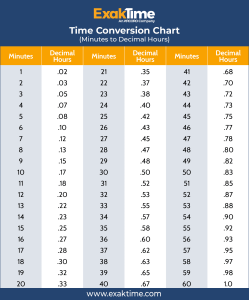
Consider this example from Business News Daily:
- If you pay an employee $15 per hour and they work seven hours and 58 minutes, then you will need to pay them $15 x 7 + $15 x (58/60) = $119.50. If you just round the time worked up to eight hours, you can simply calculate $15 x 8 = $120, and the 50-cent difference is minimal.
What rounding cannot do is save you money. While the DOL allows for some rounding, it can’t be used to cut costs. According to the DOL, time sheet rounding is allowed “where there are uncertain and indefinite periods of time involved, a few seconds or minutes in duration, and where the failure to count such time is justified by industrial realities.” In plain speak, this means it’s meant to allow for some measure of inconsistency with time tracking methods. What’s important to note here is that, as in almost all cases, the FLSA will most often rule in favor of the employee—this rule is not meant to allow businesses to take paid time away from employees.
Ultimately, employers shouldn’t turn to time record rounding simply to cut costs. If you’re saving significant amounts of money with this practice, you’re almost definitely doing it illegally – and therefore opening yourself up to FLSA lawsuits.

Rounding Best Practices
- Take regular looks at your rounding process. Rounding can easily lead to wage theft if you’re not careful. Business News Daily suggests regularly looking at your rounding practices once per pay cycle to catch any cases of excessive wage withholding.
- Always round to benefit your employees. Never round to diminish your employees’ wages, even if it will make calculating payroll easier. Slightly overpaying employees is always better than underpaying.
- Don’t allow employees to abuse the rounding system. If an employee sees that working six or seven minutes could be counted as 15, they could start abusing the system. A couple of minutes here or there is no big deal, but if it happens every day, those extra minutes could add up. If you start to see this being done, ask the employee to clock out at their exact amount of required work hours.
- Don’t let rounding lead to overtime. Rounding up for your employees’ benefit could inadvertently propel them to earn overtime wages. Be sure to watch how close your employees get to working over 40 hours per week because of rounding because you’ll have to pay them overtime, according to state and federal laws. It’s also important to note you can’t use rounding to NOT pay your employees who did work more than 40 hours in a week.
- Make a clear rounding policy. Explain your time clock rounding to your employees. Transparency is key when it comes to implementing policies that affect your employees’ paychecks. State which FLSA-compliant rounding system you’ll use and explain how employees can file wage grievances.
Want to do away with inconsistent time tracking? ExakTime by Arcoro's cloud-based time tracking system collects 100% accurate time and attendance data so you don’t even have to think about rounding for the sake of ease. Better still, this data syncs with your payroll platform—no rounding required!
Frequently Asked Questions
What is time clock rounding?
Time clock rounding is the practice of adjusting an employee's clock-in or clock-out times to the nearest set increment to simplify payroll calculations. For example, an employee who clocks in at 7:58 a.m. might have their time rounded to 8:00 a.m.
Is time clock rounding legal under the FLSA?
Yes, the Fair Labor Standards Act permits time clock rounding as long as it does not result in a failure to compensate employees for the time they actually worked over a period of time. Rounding can never be applied in a way that favors the employer over the employee.
What are the approved rounding increments?
The FLSA allows employers to round to the nearest 5-minute interval, the nearest 1/10th of an hour (every 6 minutes), or the nearest 15-minute interval. Rounding to the nearest 15 minutes is the most common option because it tends to work most easily with payroll systems.
What is the 7-minute rule?
The 7-minute rule applies when rounding to the nearest 15-minute interval. If an employee clocks in within the first 7 minutes of an interval, time is rounded down; if they clock in within the last 7 minutes, time is rounded up to the next quarter hour.
Can employers use rounding to reduce labor costs?
No, rounding cannot be used as a cost-cutting measure. If your rounding practice is saving significant amounts of money, it is almost certainly being applied illegally and could expose your business to FLSA lawsuits.
Can rounding accidentally trigger overtime?
Yes, rounding up in employees' favor could push their total hours close to or over 40 hours per week, requiring overtime pay under state and federal law. Employers should monitor hours closely to account for this possibility.
What are the best practices for a compliant rounding policy?
Always round in a way that benefits employees, review your rounding practices each pay cycle to catch excessive wage withholding, and maintain a clear written policy that explains the rounding method and how employees can file wage grievances.
Is there an alternative to time clock rounding?
Yes, using a cloud-based time tracking system like ExakTime by Arcoro captures 100% accurate time and attendance data, eliminating the need for rounding altogether and syncing directly with your payroll platform.