

Time theft. Missing employees. Inaccurate time cards piling up at the end of every pay period. In 1999, these issues weren't just annoyances: they were costing construction contractors real money. The problem was no one had built a solution that could hold up on a real job site, until one contractor decided to develop a solution.
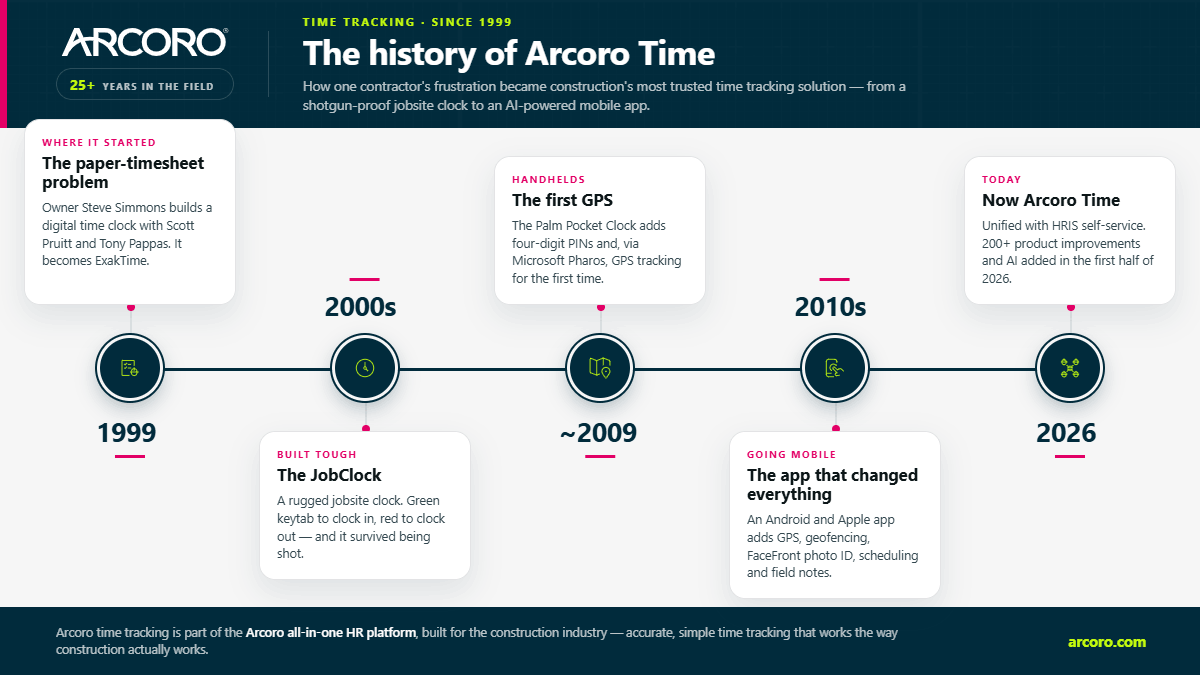
As a construction owner, Steve Simmons was living the paper time sheet problem every day. He partnered with Scott Pruitt and developer Tony Pappas to build his own digital time tracking system. That system became ExakTime.
More than 25 years later, now as part of Arcoro and rebranded as Arcoro Time, the original digital time clock solution is still doing exactly what Simmons set out to do: give contractors an accurate, simple, and reliable way to track worker time in the field.
The JobClock: Built Tough From Day One
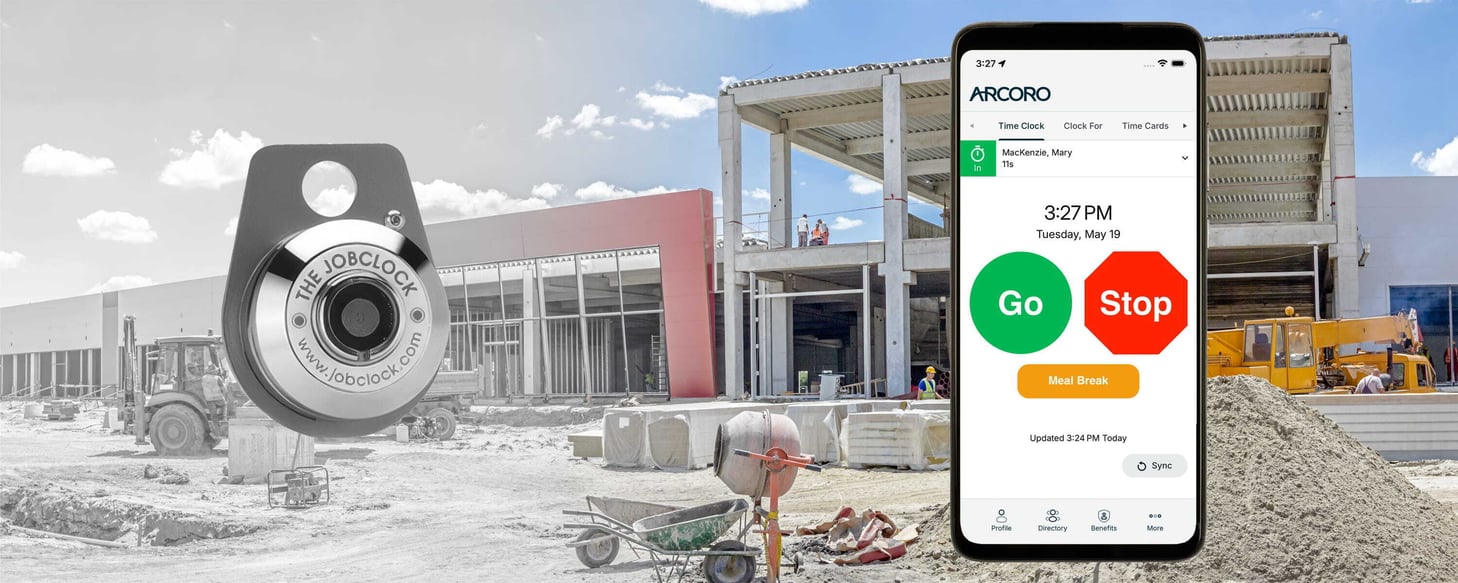
When Arcoro Time launched, smartphones didn't exist; even Palm Pilots were brand new. So Simmons and his team knew their time tracking solution needed to work where crews work – outdoors in the harshest of conditions. The JobClock, a rugged, portable time tracking device, was the answer.
The concept was straightforward. Employees used color-coded keytabs to clock in and out, green to start, red to stop. For contractors managing multiple job codes, the FastTracker expanded that capability to handle hundreds of different worker activities. Data collected at each site transferred back to the office via USB cable, and later wirelessly through Bluetooth or infrared connectivity.
What made the JobClock legendary wasn't just the technology. It was the durability. Early demonstrations showed the device getting buried underground, nailed to walls and shot with a shotgun, and still functioning. That wasn't a gimmick. On a construction site, equipment that fails under pressure is equipment that costs you. Arcoro’s JobClock didn't fail.
Today, Arcoro offers two versions of the JobClock, the Hornet and LE. Both offer the same durability, being able to withstand temperatures ranging from -10°F to 170°F, portability, and a long battery life. The difference between the two is how time clock data is transferred to your payroll system. The LE needs Bluetooth to connect, while the Hornet uploads data automatically every hour.
Handhelds Enter the Picture
About ten years after the launch of the JobClock, Arcoro recognized a shift happening in the field. Handheld devices like the Palm Pilot and Blackberry were showing up everywhere, and contractors were starting to see their potential. Arcoro responded with the Palm Pocket Clock, which introduced two significant upgrades.
First, unique four-digit PINs for every employee added a layer of accountability the keytab system couldn't match. Second, through an integration with Microsoft Pharos, Arcoro delivered GPS tracking for the first time, giving contractors documented proof that their employees were actually on site when they clocked in.
That GPS capability would prove to be one of the most important moves Arcoro ever made. But the handheld era didn't last long. Smartphones were coming, and they were coming fast.

Going Mobile: The App That Changed Everything
Arcoro saw the smartphone wave early and moved quickly, developing a mobile app available on both Android and Apple devices. The core experience stayed true to what contractors already knew: workers enter a four-digit PIN and tap green to clock in or red to clock out. Simple. Fast. Accurate.
But the mobile platform opened the door to capabilities the JobClock could never offer. Arcoro Time gradually added a whole host of features, including:
- GPS Tracking: Arcoro Time’s mobile GPS taps into 30 global positioning satellites to log exact employee locations at clock-in and clock-out. Managers could verify at a glance whether a worker was actually on site, cutting down on time theft and eliminating guesswork.
- Geofencing: Geofencing took GPS a step further by creating a virtual boundary around a job site. If an employee tried to clock in from their truck down the street or a coffee shop around the corner, the system flagged it. Only punches made inside the fence counted as on-site.
- FaceFront Photo ID Verification: Buddy punching has always been a problem on job sites. FaceFront addressed it directly by using the mobile device's front-facing camera to snap a photo at every clock-in and clock-out. Supervisors could match those photos to employee records stored in the system, making it easy to catch substitutions without relying on biometric fingerprint scanners, which can fail on dirty hands and raise data privacy concerns.
- Scheduling: The mobile app allows managers to build and assign worker schedules in advance, sending project requests based on skill sets, availability, and location, and monitoring clock-in and clock-out activity in real time from a single dashboard.
- Field Notes: Workers and supervisors in the field could record text, photos, or audio updates and push them to the cloud with one tap. Those notes attached to job records automatically, creating a clear paper trail and helping office staff send invoices faster when a project milestone is reached.
- Mobile Compliance: For contractors navigating prevailing wage, certified payroll, or other compliance requirements, the mobile app maintained a complete digital history of every punch including employee responses to compliance prompts.
The Same Mission, Over 25 Years Later
The technology has changed dramatically since Steve Simmons first sat down with Scott Pruitt and Tony Pappas to solve his time card problem. The mission hasn't.
Arcoro still builds solutions for the specific demands of the construction industry: environments that are rough, schedules that move fast, and workforces that are spread across multiple sites at once.
And while the mission hasn’t changed, the software has evolved right alongside the technology. In the first half of 2026, Arcoro delivered more than 200 product improvements and introduced AI-powered capabilities into core construction HR workflows.
For example, today, Arcoro Time users have a sleek, easy-to-use app that unifies both time tracking and Arcoro’s HRIS employee self-service information. The modern, mobile app, launched in 2026, provides an all-in-one employee experience; users can clock in and out from the field and also check benefits, pay stubs, and access the company directory.
No matter Arcoro Time’s iteration, the goal is the same one that started everything: accurate, simple time tracking that works the way construction actually works.
Twenty-five years in, that's still not a small thing.
Arcoro time tracking is part of the Arcoro all-in-one HR platform built for the construction industry. Learn more at arcoro.com.