

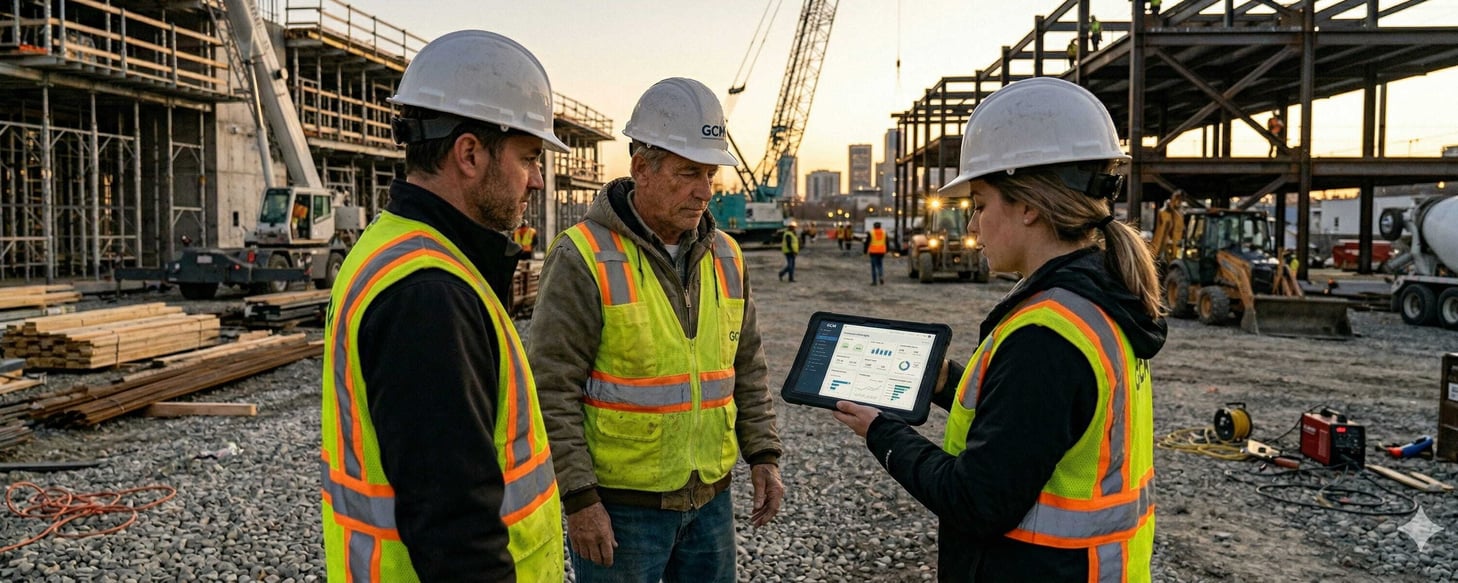
In the past year, I’ve trained, worked with, and presented to thousands of construction professionals across the country. What I hear consistently is not skepticism about AI, and not confusion about their systems. Leaders already know their payroll, time tracking, recruiting, onboarding, and training data live across multiple platforms. They already know there is valuable insight buried inside that data.
What many of the companies we work with lack is not information. It’s bandwidth.
In organizations where HR teams are lean and resources are tight, leaders often know the data exists but struggle to carve out the time required to manually pull reports, connect information across systems, and analyze trends in a meaningful way. The insight is there. The capacity to extract it consistently is not.
That is where AI changes the equation.
When layered on top of structured systems, AI allows even small teams to make sense of large volumes of workforce data in minutes instead of weeks. It turns raw information into actionable insight.
And in an industry facing sustained growth and persistent labor shortages, that capability is becoming increasingly important.
The competitive advantage in construction HR will come from leveraging AI on top of strong systems.
The Mistake: AI in Isolation
Despite this opportunity, many companies are approaching AI in ways that limit its potential.
In many organizations we work with, experimentation is already happening. Recruiters test AI tools to help draft job descriptions or summarize candidate profiles. Managers experiment with AI to generate reports or internal communications. Leaders explore different tools to see what might improve productivity.
Those experiments are useful. Curiosity is a necessary starting point.
But experimentation alone does not create strategic advantage.
Too often AI is applied in isolated moments rather than connected to the systems that already house the company’s workforce data. A recruiter may use it for a task. A manager may try it for a report. Another team may explore it for documentation. Each use case may save time individually, but the organization never unlocks the deeper value of its data.
AI acts as an accelerator, but without strong systems providing direction, that acceleration simply compounds whatever processes already exist.
The companies seeing the greatest impact are approaching the question differently.
The first question they ask is not “What AI tools should we buy?”
It’s “What could we do with the systems and data we already have?”
That shift in thinking changes everything.
When AI is applied on top of structured workforce systems, even small teams can begin identifying patterns in hiring, onboarding, training, and retention that would otherwise take weeks of analysis to uncover.
The Data Confirms the Gap
The patterns we see in the field are reinforced by recent research from Arcoro’s 2026 State of Construction HR report.
According to the study, 42% of construction HR teams say administrative tasks are holding them back from focusing on more strategic work.
At the same time, AI adoption across construction HR remains relatively early. Only 17% of companies report using AI broadly across their HR functions.
Yet the organizations that are using AI more extensively report something important: they are more likely to be growing faster than their peers.
Taken together, these findings highlight a clear gap.
Most construction companies already have large amounts of workforce data across their HR systems. Many leaders understand the potential value of that data. But relatively few organizations have begun using AI in ways that fully unlock it.
This is where the next phase of AI adoption in construction HR will occur.
The advantage will not come from experimenting with isolated AI tools. It will come from applying AI to the structured systems where workforce data already lives.
What Leading Companies Are Doing Differently
The construction companies seeing meaningful results from AI are not necessarily the ones with the most advanced technology or tech-savvy team members.
In many cases, they are simply approaching AI more strategically.
Rather than beginning with a search for new AI tools, these organizations start by looking at the systems and data they already have in place. Hiring pipelines, onboarding progress, training participation, retention patterns, and workforce deployment across projects all generate valuable information.
When those systems are structured well, they create a foundation that AI can build upon.
Rather than replacing existing workflows, AI becomes a layer that helps teams interpret what is already happening inside the organization. It can surface patterns, highlight anomalies, and generate insights that would otherwise require significant time and analytical effort.
For many HR teams, this changes the nature of their work. Instead of spending the majority of their time pulling reports, reconciling data, and responding to administrative tasks, they can begin focusing more energy on the strategic challenges that matter most: improving retention, strengthening leadership pipelines, and ensuring the organization can continue to grow.
Too often, organizations try to begin their AI journey with initiatives that do not yet exist in their business. They search for entirely new capabilities instead of first unlocking the value already sitting inside their systems.
The companies making the most progress start somewhere simpler and more practical: they begin with the data and systems they already have.
Turning Workforce Data Into Actionable Insight
To understand where this approach creates real impact, consider how many construction companies already track key workforce information across their HR systems.
Hiring pipelines show how long it takes to fill critical roles. Onboarding systems track whether new employees complete required milestones. Training programs record participation and certifications. Retention data shows which roles or teams experience higher turnover.
Individually, each of these systems provides useful information. But the real value often comes from understanding how those data points connect.
When AI is applied on top of structured workforce systems, organizations can begin identifying patterns that would otherwise take significant time to uncover.
For example, leaders may discover that certain onboarding steps correlate with higher retention among new hires. They may find that employees who complete specific training programs are more likely to move into leadership roles. They may also uncover hiring bottlenecks that slow project staffing during periods of rapid growth.
These insights allow HR leaders and executives to move beyond reacting to workforce challenges and begin addressing the underlying causes.
Instead of simply tracking data, they can use it to improve hiring strategies, strengthen leadership pipelines, and support long-term workforce stability.
And in an industry where talent availability directly affects project timelines and growth capacity, those insights can quickly translate into meaningful business impact.
Where the Competitive Advantage Emerges
For construction companies, workforce strategy has always been closely tied to business performance. Hiring delays can slow project timelines. Leadership gaps can create operational risk. High turnover increases both cost and disruption.
What is changing now is the ability to see and address those issues earlier.
When AI is applied on top of structured HR systems, workforce data becomes more than a record of past activity. It becomes a decision-making tool that helps leaders understand what is happening inside their organization and where improvements can have the greatest impact.
Executives can begin identifying patterns in hiring demand, training effectiveness, and retention trends that would otherwise remain buried inside reports or disconnected systems.
Over time, those insights compound.
Companies that are able to consistently learn from their workforce data can refine hiring strategies, strengthen leadership development, and create more predictable growth. They are better positioned to respond to labor shortages, expand into new markets, and maintain stability across projects.
In this way, AI does not replace the role of HR leaders or operational executives. It strengthens their ability to make informed decisions.
And for organizations that approach AI strategically, that capability becomes a meaningful competitive advantage.
The Leaders Who Move First
Most construction companies are not trying to become technology companies. Their focus is delivering projects safely, efficiently, and profitably.
But the organizations that gain the most advantage from AI will be the ones that apply it in practical ways that strengthen the systems already supporting their workforce.
When AI is layered on top of strong HR systems, leaders gain faster insight into hiring trends, retention risks, and workforce development opportunities. That clarity allows them to make better decisions about how to build and grow their teams.
The companies that move first will not simply adopt AI. They will use it to unlock the full value of the data already inside their organization.
Zach Giglio will be the keynote speaker at Elevate 2026 in Dallas, Texas on April 28.

Zach Giglio is CEO of GCM, an award-winning agency that shows organizations how to leverage cutting-edge AI technology to become more efficient and profitable. He is certified by the Wharton School of Business in AI strategy for business and is a curriculum committee member on AI at the U.S. Chamber of Commerce’s Institute for Organization Management.
Renowned for his insights into the fascinating convergence of AI and business, Zach is a frequent keynote speaker at industry conferences, a TEDx speaker and a multi-award winning consultant. Additionally, he conducts intensive AI trainings and implementations, tailored to equip organizations with the requisite knowledge and skills to effectively harness AI, fueling their operations, sales, marketing and administration abilities and driving revenue growth.
Zach's consulting acumen spans a diverse array of organizations, from Fortune 500 companies to dynamic startups. His professional journey has taken him from Washington D.C. to Johannesburg and back to the USA, where he co-founded GCM.
Beyond his professional commitments, Zach contributes actively to his local community, being a member of multiple nonprofit organizations. He indulges his personal passions in travel, food, and conversation, underpinned by a lifelong love for storytelling, history, and culture. Zach resides in the Charleston, S.C. area with his wife and three children.